
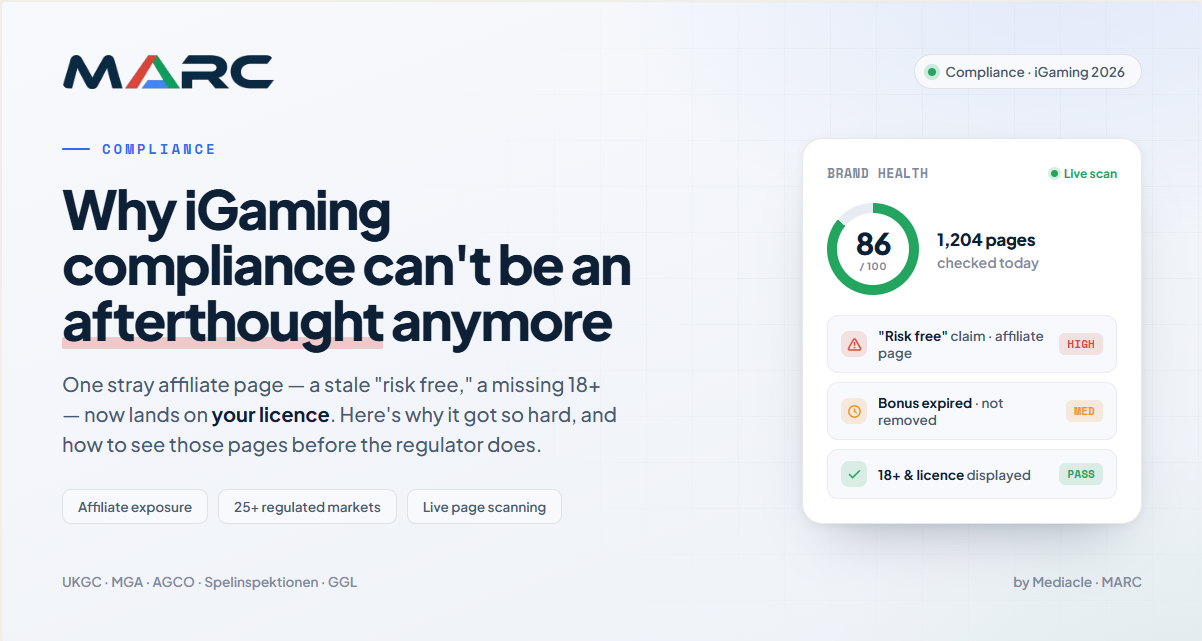
Somewhere out there right now, on a page you have never seen and did not write, your brand name is sitting next to the words 'risk free' and a welcome bonus that quietly expired back in the spring. You do not know about it yet. The affiliate who published it has long since moved on to the next thing and is not really thinking about it either. But the regulator, if they happen to wander past that page on the wrong Tuesday morning, will treat it as yours, because the licence on the line is yours and the brand is yours, full stop. That is the quiet, uncomfortable shape of iGaming compliance these days, and it is exactly the sort of thing that has compliance people lying awake at two in the morning, going through pages in their head.
So why did compliance get so much harder
We hear about it more or less constantly over here at MARC, the same worried question turning up again and again, usually sounding a bit tired and a bit stretched thin. 'We run a decent brand, our licence is in order, our own site is spotless, so why does compliance still feel like a thing that could blow up on us any given morning?' And honestly, fair enough. Gambling compliance stopped being a once-a-quarter tidy-up job a good while back, and a lot of teams are still quietly treating it like it is one, and that gap right there is where all the trouble lives. So let us talk about it properly, not the scary version and not the salesy version either, just the honest shape of why this got so hard and what you can realistically do about it. Right then, here we go.
The short answer is that your regulatory exposure does not live where you can see it anymore. Years and years back, keeping compliant basically meant keeping your own website in order, and that was a job one person could hold in their own head. These days your brand is being marketed across thousands of pages you never wrote and never approved, by affiliates publishing reviews and bonus tables and quick little landing pages spun up for one campaign, and every single one of those carries your licence right along with it whether you knew it existed or not.
And here is the part that catches people out. When an affiliate leaves a stale 'risk free' claim sitting next to your offer, or forgets the 18+ badge, or lists a bonus that expired months ago, the regulator does not go knocking on the affiliate's door about it. It lands on your licence, because you are the operator and the brand is yours, full stop. So you carry the risk for content you cannot even see without going and looking for it, page by page, one at a time.
Then on top of all that the rules keep moving underneath you. The UKGC has spent the last year tightening its grip, and the MGA over in Malta, Spelinspektionen up in Sweden, the GGL in Germany, the whole crowd of them update their requirements again and again, and a page that was perfectly fine last quarter can be a genuine violation this quarter without a single word on it changing.
Where it quietly goes wrong
The way most teams handle this, if we are being totally honest here, is with spreadsheets and good intentions. Somebody takes a few screenshots, pastes them into a sheet, checks a handful of URLs by hand, emails the findings round, and calls it a review. And that genuinely works until it does not, which is roughly the moment you get past your first hundred pages, because manual spot checks only ever see a thin little slice of what is actually live, and always after the fact.
The external audit route is not much kinder either. A proper outside audit costs you tens of thousands, takes weeks, and is basically stale the day it lands in your inbox, because the affiliates have already published forty more pages while you were reading it.
Regulators, mind you, do not politely wait for your next audit cycle to come round.
What MARC actually does about it
This is the whole reason we built MARC, and the short version is that it turns compliance from a quarterly panic into something that just quietly runs in the background instead. MARC is our cloud platform that goes out and scans every page you and your affiliates publish, checking the offers, the terms, the wording and the licensing against the actual rulebook of the market that page is aimed at, and then it scores the lot in one live dashboard so you can see where you stand at a glance rather than guessing.
The bit people tend to like most is that it does not just run a dumb keyword list. MARC uses vision and language models that read a page the way a regulator would, the copy and the offers and the badges and the screenshots all together, because context is everything with this stuff. The same phrase can be perfectly fine in one sentence and a clear violation sitting right next to a call to action, and a plain word search will never spot that difference.
And it reads each page the way a local user sees it too, so a UK page gets held to UKGC rules, an Ontario page to the AGCO, a New Jersey page to its 21 plus rules, and so on across 25+ regulated markets, each checked for the same core things, the banned wording, the responsible gambling messaging, the licence and age display, and the advertising limits that particular regulator cares about.
When it finds something it does not just wag a finger and leave you to it. Each finding rolls into a health score out of 100, gets sorted by severity, and MARC turns it into a plain report you can send straight to the affiliate with the exact fix spelt out. Then it rechecks the live page once they have sorted it and tracks the whole thing through to resolution. So instead of a fire drill every few months you get one standing, tidy pipeline, from finding the page all the way to the page being fixed.
Frequently asked questions
The final word
Compliance used to be something you could sensibly leave to the end of the quarter, and those days are simply gone, because the risk moved out onto pages you cannot see and the rules stopped sitting still. You do not need to boil the ocean over it, though, and you definitely do not need to hire a room full of people to check URLs one by one until they lose the will. You just need the checking to happen on its own, quietly, every day, across every page and every market that carries your name.
That is the whole job MARC was built to do, and the easiest way to see whether it earns its keep is to point it at your own brand and watch what turns up. Book yourself a quick demo, add a brand, let it run one scan, and see the findings roll into a single health score.
Far better you see those pages first than the regulator does.
Anna Whitfield
Head of Compliance, Mediacle
Part of the team building MARC - Mediacle's Audit & Regulatory Compliance Platform for iGaming brands and their affiliates.