
There is a habit in marketing teams that nobody wrote down and nobody would defend out loud, and it works like this, the things that have a web address get checked and the things that do not have a web address go out on somebody's good judgement. A landing page gets its link pasted into a thread, and legal opens it, and a person with the authority to do so goes and signs the thing off. An email does not get that. A push notification does not get that. The three lines sitting on a paid social creative do not get it either, on account of there being nothing to open and nothing to click, just a file in a shared folder and a send date and somebody who is fairly sure it reads fine.
A sign-off that travelled with the sentence
And it does read fine. That is the awkward part of it. Nobody here is being careless and nobody is cutting a corner they know about, the corner simply is not visible from where they are standing.
Declan found his on a Friday and he was not looking for it. He had gone into the campaign folder to pull old creatives for a market that launched last quarter, which is the sensible thing to do, you reuse what worked rather than start again from nothing, everybody does it, it is half of what a campaign folder is for in the first place. There was an email in there from the spring, sent to a list in a market that is not the UK, and he opened it to see how the banner had sat above the copy. The layout was grand. It was the subject line that stopped him, and he read it twice before he was sure of it, on account of it being a line he recognised. He recognised it because he had written it himself, eleven months earlier, for a UK landing page, where somebody had gone and approved it properly and signed their name to it.
The approval travelled with the words and not one person decided that it should, there was no meeting where somebody stood up and proposed that a sign-off granted for one market ought to go and follow a sentence into another one. It just did, the way a file does, and the sentence arrived somewhere new wearing a tick it had earned somewhere else entirely.
Fair is fair, the email had gone out months before and nothing came of it. That is how most of them end, truth be told, and it is exactly why they keep on happening.
How a line of copy gets through four people
Not one person in that chain did a thing wrong, and that is what makes it a difficult one to fix. A writer drafts the campaign and reuses a subject line that performed well, because performing well is what the performance data is there to tell you. A designer drops it onto the creative. A campaign manager schedules it against the send calendar. Somebody senior looks at the whole thing for about ninety seconds and sees a line they have seen before and approved before, so it does not catch on anything, on account of familiarity being the exact opposite of the thing you want in a person who is meant to be checking something.
Then the compliance review happens on the landing page. And the landing page is spotless, genuinely, it has the age badge and the licence details and the terms sitting exactly where they should be, because the landing page is the thing that gets reviewed and every single person involved knows it gets reviewed.
The email that drove the traffic to it was never in scope. It was not withheld from anybody and it was not hidden, it was simply not the sort of object the review had been built around in the first place, there being no URL to paste and no page to open and no obvious door for a thing like that to come in through, and so it never does come in.
The same gap sits under push notifications, in-app messages, SMS to a lapsed segment, the copy on a display banner that a media agency serves on your behalf, and the affiliate creative packs you send out for other people to publish. Every bit of that is advertising and it all sits under your licence, and hardly any of it has a web address at the moment somebody sits down and writes it.
The words that only go wrong in certain countries
Some copy is wrong everywhere and you could find it with a text search if you were diligent about running one. Risk free. Guaranteed wins. Easy money. Anything that promises an outcome a gambling product is in no position to promise, and those ones are at least honest about themselves, they look like a problem when you read them.
The harder set is the copy that is only wrong in some places. A bonus described one way passes in one market and does not pass in the next, the same sentence, the same product, nothing changed about it except the list it went to. Urgency framing that is unremarkable in one jurisdiction reads as an inducement one border over. And the disclosure requirements move as well, what has to appear beside an offer, how the age restriction has to be shown, whether the responsible gambling message needs to sit in the asset its self or whether a link across to it will do.
None of that is visible in the words. You cannot look at a subject line and see which markets it is allowed in, you have to already know, and knowing means carrying a few dozen rulebooks around in your head at the same time as writing something a person might actually want to open.
Then there is a third kind, quieter than either of those. Copy that is fine in its self but arrives missing something. No 18+ anywhere on the creative. No licence reference. No responsible gambling line, or one that was there in the desktop version and went missing when the thing got resized and something had to give. Nothing was said that should not have been said. Something just was not said at all, and an absence is far harder to catch than a bad phrase, on account of absences not turning up in a text search.
Nobody re-checks a line that already passed once
Ask a compliance team which copy worries them and most will point at the new material, the launch campaign, the thing being written under pressure the week before it has to go. That is a reasonable answer and it is also backwards for this particular problem.
New copy gets attention. It is new, somebody is nervous about it, it goes round for comment and it comes back marked up. Reused copy gets none of that, and reused copy is most of what goes out. A subject line that worked once goes into the template, the template goes to the next market, the next market has its own rules, and at no point in that sequence does anybody feel they have made a decision. They copied a file. Copying a file does not feel the least bit like an act that needs a legal review attached to it.
The volume finishes the argument off. A brand running four markets with an email a week, a couple of pushes, a paid social set and whatever goes into the affiliate pack is producing a few hundred pieces of copy in a quarter without anybody in the building thinking of it as a publishing operation. A person can read a few hundred pieces of copy. A person cannot read a few hundred pieces of copy against four separate rulebooks and stay sharp while doing it, and the attention goes somewhere around the fortieth one.
Reading a draft the way a regulator reads a finished ad
Here is a small example and I have made it up, and I have made it deliberately dull as well, on account of the real ones being dull.
An email is going out to a segment in a market you opened last quarter, and the subject line promises a bonus using a phrase that tested well at home, and the preview text underneath it carries the amount. The body has the offer, a button, and a footer with the licence line and the age restriction sitting in it, because the footer was built once and the footer is correct.
A proper check does not read any of that as prose, it reads it as a set of claims and a set of required elements and then goes through them one at a time without getting bored of it around the fourth one. What is being promised here, and does this market permit a promise built in that shape. Is the offer named in the subject line the same offer that exists in the terms today, because those two drift apart on their own without anybody touching either of them. Is every element that has to be present present in this asset, not on the page the asset links across to, in the asset. Do the age and licence and responsible gambling elements survive at the size the thing is going to be looked at.
Then it goes and does the whole lot again for the other market and comes back with a different answer, because the rulebook underneath it changed.
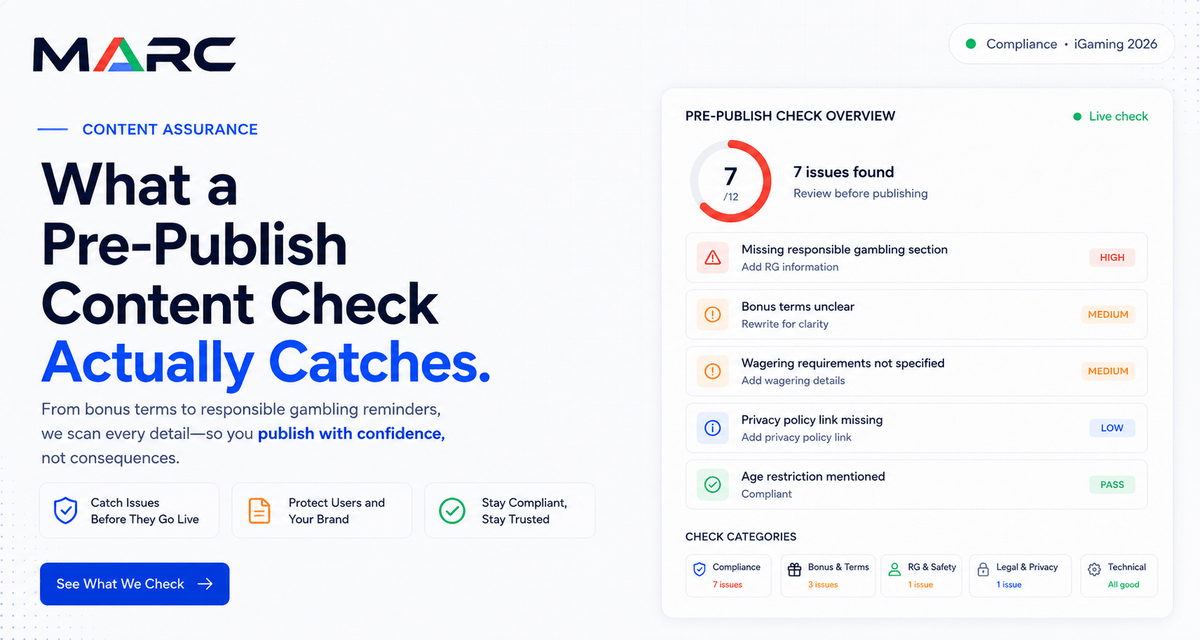
The Content Checker over here at MARC is built for exactly that job, and it runs in the order you would want it to run in. The regulators go first, which is the step that decides everything after it. You say which authorities the copy is actually going out under, and there are a hundred and fifty five of them in there, so the market you opened last quarter is already sitting in the list. Then the content itself, pasted in or uploaded, the email or the creative or the three lines off a push, and no web address is wanted at any stage on account of there not being a page yet. Then the scan, which reads the copy against each rulebook you picked rather than against one general checklist, flagging the misleading claims and the banned wording and the disclosures that are not in there.
And what comes back is not only the flag. Each one arrives with the reason it was raised and the market that raised it and suggested wording that would clear it, which does more work than it sounds like it should. Sent back on its own, a flag is a problem handed to the writer, and the writer is the one person in the building who did not know the rule in the first place, so it goes into a queue and comes round again a week later no better understood than it went in. Put the wording beside it and most of them close in the same sitting. It sits on the Pro plan. The Landing Page Checker does a similar job once a page exists and has a URL somebody can paste. The Content Checker is for the stage before that, while the thing is still sitting in a document with nothing depending on it yet.
What a checker will not decide for you
A flag is not a breach. It is a thing worth a look, and some share of them will turn out to be nothing at all, a phrase that reads badly to a classifier and reads perfectly fine to anybody in that market who knows what is meant by it. Somebody who understands the jurisdiction still has to make that call. And MARC's own output is AI generated, it can be incomplete, it can be wrong, and it is not legal advice. We say that plainly in the disclaimer and it is worth repeating up here rather than leaving it down in the small print.
The suggested wording wants reading in the same spirit. It is a starting point rather than a verdict, put together by a system that has read your copy against a rulebook, and it goes into the document only when somebody has looked at it and is happy with it. Take one and scan the thing again, on account of a rewrite being well able to introduce a new problem as neatly as it cleared the old one, and a second pass on a document costing nothing at all.
There is judgement a checker cannot reach at all, mind you. Whether a campaign taken as a whole is pointed at people it has no business being pointed at, or whether the tone of the thing is leaning a bit hard on somebody who happens to be having a bad month of it. Those are not word problems and no amount of checking the words is going to settle them.
And a pre-publish check only earns its keep if the copy that gets published is the copy that got checked. Things move after approval. A line gets shortened to fit a character limit. A market manager changes one word to sound more local. The creative gets resized for a placement and the footer is what goes. Checking the draft is the cheap half of it and it does not solve the other half, on account of the other half being a question of who does what and in what order, and nobody has ever bought software that sorted that out for them.
What changes for Declan is not that he stops finding these. It is that he finds them before the send button instead of eleven months after it.
A thing worth doing before your next campaign goes out
Take one campaign that has already gone. Not the quarter, one campaign. Write down every asset in it that carried words, and I do mean every one, the emails, the pushes, the social creative, the banner copy the agency served for you, the affiliate pack, the SMS if you sent an SMS. Then put a mark beside each one that a compliance person actually read before it went out the door.
The first time somebody runs that exercise they are usually taken aback at how short the second list turns out to be next to the first. The gap between the two is the whole thing, and it is worth seeing that your own self rather than being told about it by anybody, us included.
If the gap bothers you, go and check one of the unmarked assets properly, by hand, against the rulebook of the market it went to. It will take you twenty minutes or so and it will teach you more than another article on the subject will. Then multiply the twenty minutes by the number of assets you wrote down, and again by the number of markets you sell in, and you will arrive fairly quickly at the point where doing this by hand stops being a sensible way to spend anybody's week.
That is the point MARC is built for. You can put your own drafts through it in a demo, which will tell you more about whether it suits you than any amount of this will.
Anna Whitfield
Head of Compliance, Mediacle
Part of the team building MARC - Mediacle's Audit & Regulatory Compliance Platform for iGaming brands and their affiliates.