
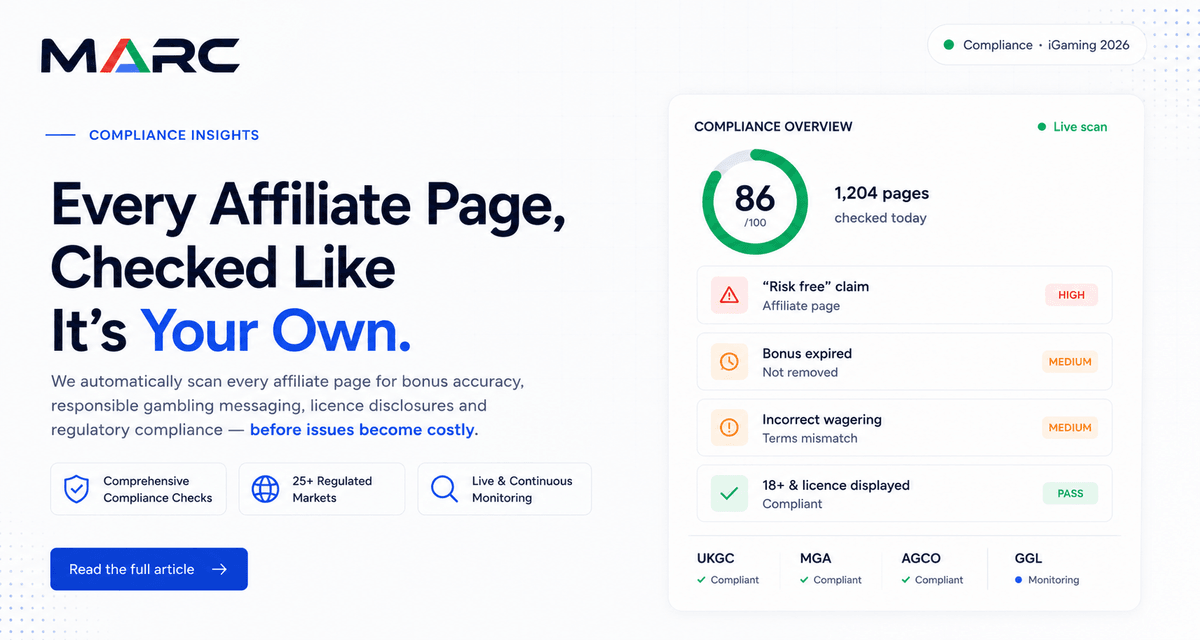
Affiliate compliance is the work of keeping everything published about your brand by somebody who is not you inside the rules you hold your licence under. That is the whole of it, put plainly, and it reads simple enough sitting there in the one sentence. It stops being simple the moment somebody goes and counts the pages. Nobody hands you that count. There is no register anywhere of every page currently describing your welcome offer to the world, and the ones that would surprise you most are exactly the ones no list of yours has ever had on it.
The worst way to find a page
Owen found his by way of a complaint, which is the worst way there is to find one. He runs the affiliate programme for a group with three brands, and a player wrote in to support one Tuesday saying he had been promised a hundred free spins and had been given fifty. Support checked, on account of that being what support does, and the brand had never run a hundred. Not that year and not the year before it either. The offer the player had read about had lived for three weeks the previous autumn on a partner's review page, and it was sitting there still, eleven months later, ranking away nicely and doing everything a good page is supposed to do. Nobody had gone and told the affiliate it ended. Nobody had thought to, truth be told, since nobody owned that particular job. And without the complaint arriving the way it did, that page would be sitting there yet.
That is the ordinary shape of it. Not fraud, not a partner going rogue, just a page that was true once and has not been true for a good while.
Why a page you do not own is still yours
The commercial arrangement and the regulatory one do not agree with each other, and that disagreement is the root of the whole business. Commercially an affiliate is a third party. You have an agreement with them, they send you traffic, you pay them for what converts, and what sits on their site is their own affair on their own hosting bill. The rulebook does not see it that way at all. Under the regimes most operators work inside, the UKGC and the MGA and Spelinspektionen and the others, marketing carried out on your behalf is marketing you answer for, and on your behalf gets read generously rather than narrowly. A page that promotes your brand, and gets paid for promoting your brand, is your marketing whatever the invoice says. You did not write it. You never saw it before it went up and you have no login to the thing, and you are answerable for it regardless, which is a genuinely awkward position to be handed and one most people outside the discipline do not quite believe until it is explained to them twice.
Fair is fair, most partners are not trying it on. The serious ones have compliance people of their own and care a great deal about staying inside the lines, on account of their own business depending on operators being willing to work with them. The trouble is not intent. The trouble is that a page, once published, has no reason at all to change, and your offers and your rules and your markets change constantly, and nothing connects those two facts to each other unless somebody builds the connection deliberately.
So what goes quietly wrong on somebody else's page
Stale offers make up the bulk of it, and by a distance. You change a promotion, quite properly, because the campaign team has a job to do and doing it means moving the wagering or the expiry or the minimum deposit. The change lands on your own pages, properly and on time. It does not go anywhere near the partner, since there is rarely a mechanism for it to, and from where the partner sits the page is finished, it is published, it was accurate the week it went up and it has been earning quietly ever since. Why would they go and open it again.
Then there are the significant conditions, and things get finer there. A partner states the headline correctly, a hundred percent match, and puts the wagering requirement three paragraphs down or behind a link or in a table at the bottom of a comparison of eleven brands, all of which is perfectly normal practice and none of which is done to hide anything. Whether that counts as the conditions sitting with the claim is a judgement that differs by market, mind you, and a partner working across six markets is not going and making that judgement six separate times. They are making it once, in their template, and the template was built for whichever market they started in.
Age and responsible gambling messaging goes missing for reasons duller than you would hope. Templates, mostly. A partner rebuilds their site or moves their bonus tables into something that renders nicer on a phone, and the small print that used to sit underneath does not survive the move, and nobody notices on account of nobody reading their own small print after the third time.
Words as well. Risk free is the famous one, and there are others that a given regulator has views about, and they creep back in the way weeds do, through a page written quickly by somebody covering for somebody else. Nobody put it back in on purpose. It got typed by somebody who had read it a hundred times in old copy and had no notion it had ever been a problem.
Then there is the question of where the page is being served and to whom. A partner running a page into a market where your brand does not hold a licence is a problem that has nothing to do with what the page says. The page can be perfect. It is still pointing players in a country you cannot legally take them from at a brand of yours.
Brand bidding sits in here too, though most teams file it under commercial rather than compliance, and it belongs in both. A partner buying your brand name on paid search, against the terms of the agreement they signed, is one version of it. The other version is an ad running against your brand that belongs to somebody you have never heard of and have no agreement with at all, which is a different problem entirely and a worse one.
And underneath the whole of it, sub-affiliates. A partner buys traffic from somebody else, and that somebody has their own page, with their own version of your offer, and you have no agreement with them and frequently no idea they exist. They are not on the list. They were never going to be on the list. Their page is still your marketing.
The list of partners is never the list of pages
Most programmes monitor by partner, on account of the partner list being the thing you actually have. It sits in a spreadsheet or in the affiliate platform, it has names and contact details and commercial terms against each one, and it feels like the right place to start because it is the only place there is to start. And it is exactly the wrong shape for the problem.
The partner list tells you who you pay. It does not tell you what pages exist, or how many, or which markets they are being served into, or what they currently say. A single partner might have your brand on a review page, a bonus comparison table, a country landing page, a news post from last year and a page on a second site you did not know they owned. That is five surfaces from one line in your spreadsheet. Two hundred partners is not two hundred pages to check. It is closer to a couple of thousand, and the ones that break are disproportionately the ones you never knew about, since a page nobody knows about is a page nobody has ever gone and updated.
Scale does the rest of the damage, and it does it in a way that is easy to miss when you are drawing up the rota for who checks what. The work looks like reading. It is not reading, it is comparing, and those two things are nothing like each other as far as a human head is concerned. A wagering figure on a partner page is not wrong on its face. It is only wrong against the figure you are running this week, and that figure has to be sitting in your memory at the moment your eye passes over the other one, accurately, for four brands, across however many markets you are live in. People are poor at that after about twenty minutes and worse than poor after an hour, truth be told, and the failure of it is not really that they miss things. It is that they go on quietly seeing what they went in expecting to see.
And the cadence never lines up either. Programmes that do check tend to check quarterly, or when somebody has a quiet week, or after a regulator has gone and asked a question about something else entirely, while the pages themselves change whenever a partner feels like changing them, which is to say without warning and without telling anybody. A quarterly check on a surface that moves monthly is not really monitoring at all, it is sampling, and an eleven month old page survives sampling comfortably on account of there having been eleven months of chances to miss it.
What a proper check lines up, field by field
Take something ordinary. Fifty free spins on sign up, forty times wagering on the winnings from them, seven days before they expire, ten pounds in before you qualify. Invented figures, obviously, since the point of the example is the fields rather than the numbers.
A useful check does not go asking whether a partner page looks compliant, on account of almost all of them looking compliant. It asks a narrower thing, which is whether what that page states is what you are running this morning, and then whether the way it states it satisfies the market it is being served into. So the count of the spins first, since that is the number people copy and the number that changes. The wagering figure after it, and the quieter question sitting underneath that one of what exactly the wagering applies to, the winnings only or something broader, a distinction that travels badly between sites and moves the real value of the offer around a great deal. Then expiry, and the qualifying deposit, and any cap on what a player can walk away with, and which games the spins are actually good on, since that last one lives in a table near the bottom of a terms page and almost nobody reads that far. Not the players and not the people doing the checking either.
After the figures come the parts that are not figures at all, and they get missed twice as often on account of there being no number to compare them against. Whether the age messaging survived the partner's template. Whether the responsible gambling link goes anywhere or just looks like it does. Whether the significant conditions sit beside the claim or a click away from it, which is a different answer in different markets. And whether any word on the page is a word the regulator in that market has a settled view about.
That is a lot of comparisons for one offer on one page, and there are hundreds of pages behind it, and the work of it is dull in a way that wears people down faster than difficult work does. Most of the individual calls are easy enough for anybody who knows the market to make in a few seconds. It is having to make several thousand of them in a row, on a Wednesday, with the rest of the week still to do, that nobody has ever found a way of doing well by hand.
Over here at MARC the Affiliate Audit is the piece built to go looking for the pages in the first place, including the ones that were never on anybody's partner list, which is usually where the interesting findings are. The Offers and Terms Checker takes what those pages state and lines the fields up against what you are running now and against the rulebooks of the markets you hold licences in, all 155 licensing authorities of them. The Compliance Report puts the result somewhere you can hand it to somebody, country by country or partner by partner, which matters more than it sounds like it should, on account of the person who needs to act on a finding usually not being the person who found it.
The part of it that does not solve its self
A flag is not a breach. What an automated comparison turns up is two things that do not agree with each other, and there are perfectly ordinary reasons for two things not to agree, a partner running behind being the common one and a market requiring its own form of words being the other. Sorting the first from the second wants somebody who knows that market well enough to be sure of it, and no amount of coverage goes and buys you that. It should not, either. A tool confident enough to make that call on its own would be a worse tool by some distance, and a genuinely dangerous one to have sitting between you and your licence.
Then there is the gap between spotting a thing and getting it changed, which is the honest frustration of the whole discipline and the part nobody warns you about. Affiliates are people. Some of them answer within the hour and correct a page the same afternoon. Some have moved on, or sold the site, or handed it to somebody who does not know what a significant condition is, and those pages sit there while the emails go back and forward. A sub-affiliate page you have no agreement with is slower again, since you have no lever at all beyond asking the partner who bought the traffic to have a word.
And there is the awkward one, that removing a partner is a commercial decision rather than a compliance one. A programme's best performer is rarely its tidiest, and the conversation about what to do with a partner who converts beautifully and updates nothing is a conversation that happens well above the compliance desk. Owen still has to do the deciding his own self. What the tooling changes is only that the deciding happens on a Monday, off a list, instead of on a Tuesday, off a complaint.
Where to start, if this sounds familiar
Take ten partners. Not the programme, ten, and pick the ones sending the most traffic rather than the ones you like best. Search your brand alongside the word bonus, open whatever comes back, and put what those pages say next to what you are running this week. Give it an afternoon and do it your own self rather than delegating it, since the point of the exercise is partly to see the gap with your own eyes.
Most people doing that for the first time turn something up before the afternoon is out. If ten partners give you three findings, do the arithmetic on two hundred of them and sit with the number for a minute. It was never a partner problem. It is a question of how much of your own estate you can actually see, and seeing more of it by hand means somebody doing that afternoon over and over until the year is out, which is roughly the point where checking by hand stops being a sensible use of anybody's week. If you want to see what the rest of the estate looks like, a demo run against your own live pages will tell you more in twenty minutes than any amount of reading on the subject.
Anna Whitfield
Head of Compliance, Mediacle
Part of the team building MARC - Mediacle's Audit & Regulatory Compliance Platform for iGaming brands and their affiliates.