
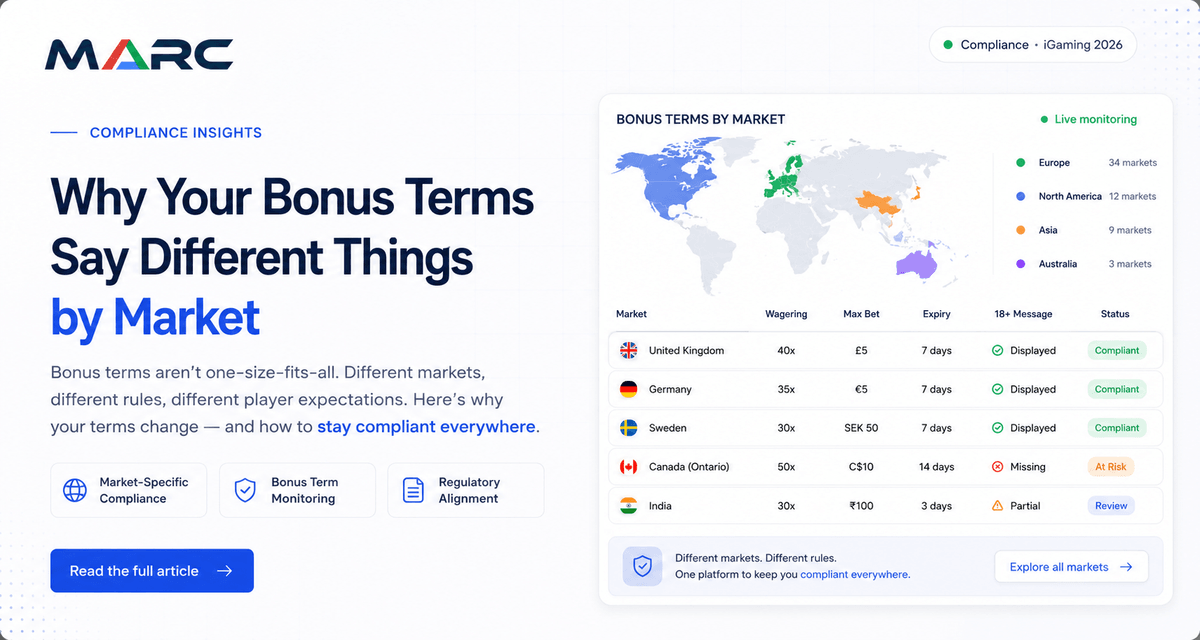
Offer drift is what happens when a single promotion quietly turns into several slightly different promotions, spread across your landing pages and your terms and conditions and whatever your affiliates published about it, without anybody ever deciding that it should. Nobody signs off on it. There is no meeting where somebody proposes that the Swedish page should carry a wagering figure the English page has never heard of. It just accumulates, a little at a time, and then one Thursday somebody notices the shape of it.
Two tabs open on a Thursday
Ruth noticed on a Thursday. She runs compliance for a group with four brands across a handful of markets, and she had two tabs open next to each other for a reason that had nothing to do with bonuses, she was checking something else entirely. One tab had the welcome offer as the campaign team had written it. The other had the terms page that offer pointed at. The headline said one wagering requirement and the terms underneath said another, and both had been sitting there live for weeks, and the honest part of it is that she only found the thing by accident, on a morning she had set aside for something else completely. That is how most of these turn up, truth be told. The audit did not catch it and nobody went looking for it, somebody just happened to have two tabs open at the same time.
So how does one bonus go and become four
The thing starts innocently, which is the part that makes it hard to catch. A promotion gets written once, properly, by somebody who knows the rules. Then it goes out into the world and the world does what it does to it. Nobody is watching that bit.
Localisation takes the first bite. The offer gets translated for a second market, and translation is never only translation, on account of every market having its own disclosure habits and its own regulator with its own view on what a bonus may be called. So the Swedish version gets adjusted, sensibly, by somebody who knows Sweden and knows it properly. The German one gets adjusted separately, over at the other end of the same campaign, by somebody who knows Germany that way. Neither of them went and did a single thing wrong. But there are now three versions of a thing that used to be one version, and no single page anywhere shows you all three at once.
Then the offer changes. Campaign teams update offers constantly, it is the whole of their job, and when the wagering drops or the expiry moves or the minimum deposit shifts, the update lands wherever the person doing it happens to be looking. The main landing page gets it. The terms page gets it a day later, or it does not. The market-specific pages, which somebody built for a campaign back in the spring and has not opened since, keep on quietly serving the old figure to anyone who lands on them, and none of it looks the least bit broken from the outside.
And then there are the affiliates, who copied your offer at some point into their own review pages and bonus tables, and who copied it accurately, mind you, at the moment they copied it. That was the version that was true that week. None of it is visible from your own site. They have not gone back to check since, because from where they sit the page is finished, it is published, it is working away fine. Why would they go and look at it twice. Your offer moved underneath them and nobody sent word. So there are four versions of the one bonus sitting out there by now, and nobody in the whole of it did a thing you could fairly call careless.
Where the versions quietly stop matching
You would think the mismatches would show up in the headline number, the big one, the figure in the largest font. Sometimes they do. More often the headline is the one thing everybody remembers to update, on account of it being the thing everybody looks at, and the drift settles into the quieter fields instead.
Wagering requirements are the usual suspect, particularly the difference between wagering on the bonus and wagering on bonus plus deposit, which is a distinction that survives translation badly and which changes the real value of an offer enormously. Expiry dates drift as well, both the offer expiry and the separate question of how long a player has to meet the requirement once they have taken it. Minimum deposit, maximum bet while a bonus is active, which games contribute and at what rate, whether the country the page is being served into is even eligible for the offer at all. Game contribution rates are a particularly quiet one, since they sit in a table three quarters of the way down a terms page and almost nobody reads that far, not the players and not the people doing the checking either. That one gets missed constantly.
And then the things that are not figures at all. Whether the significant conditions sit next to the offer or only on a page one click away. Whether the age and responsible gambling messaging survived the affiliate's template. Whether some word that a regulator has views about, risk free being the obvious one, went and crept back into a version somebody wrote in a hurry. That last category is not really drift so much as it is decay, but it arrives the very same way, by nobody looking for a long enough while.
Why the pages you check are never the pages that break
Most teams do check, mind you, and the effort is genuinely there, which is what makes this particular failure such an annoying one to sit and explain. They check the main landing pages, they check the flagship brand, they check the market that matters most this quarter. What they check is chosen by importance, which feels like the correct way to choose, and it is exactly backwards for this particular problem. The pages that get checked are the pages that get attention, and the pages that get attention are the pages that get updated, so the checking lands over and over on the pages least likely to have drifted. Meanwhile the market page nobody has opened since spring sits there being wrong, precisely because nobody has opened it since spring.
Scale finishes the job. A group with a few brands across a few markets, each with its own landing pages and terms pages and a spread of affiliate pages behind it, is looking at hundreds of live surfaces where an offer is stated. Somebody checking by hand can hold maybe a couple of dozen in a session before their eyes go, and after that they start reading what they expect to be sitting there instead of what actually is. And a mismatch between two numbers on two different pages is not a thing you can spot by reading one page at a time, which is the only way a person can read, so you would have to be holding the terms page in your head while you read the landing page. Try that for an hour and see how you get on with it your own self.
What a proper comparison actually lines up
Say the offer is a hundred percent match up to two hundred, thirty five times wagering, thirty days to clear it, twenty minimum deposit. Numbers invented for the sake of the example, mind you, but the shape of it is real enough.
A useful check does not ask whether that page looks compliant. It asks whether every surface stating that offer states the very same thing, and it asks it field by field. The headline claim on the landing page against the significant conditions sitting near it. Those against the full terms page they link to. All of that against what the market-specific version says, and against what each affiliate published, and against what the offer is actually configured to do in the platform, which is the comparison that gets skipped most often and which is the one that decides whether a player who takes the offer gets what the page promised them. Then the same again for each market, since the rules underneath differ and a page that is fine for one licence can be a problem under the next one over.
That is a lot of comparisons, and it is dull work, and it is the sort of dull work machines are genuinely better at than people are. The judgement is rarely the hard part of it, it is the sheer volume that defeats people in the end. Over here at MARC that is what the Offers and Terms Checker does, it pulls the stated offer off each surface and lines the fields up against each other and tells you where they disagree, across the markets you operate in, against the rulebooks of the authorities you hold licences under. The Landing Page Checker does the same job before a page goes live rather than after, which is the cheaper moment to find out. And the Affiliate Audit goes looking for the pages you did not know were stating your offer in the first place, which is usually where the interesting findings are.
The part where this does not solve its self
Fair is fair, so here are the limits.
An automated check finds mismatches, and a mismatch is not the same thing as a violation. Sometimes the two pages disagree because one of them is wrong, and sometimes they disagree because the market genuinely requires them to differ, and telling those two apart is a judgement call that belongs to a person who knows the market. That part does not automate. What the tooling buys you is that the judgement call arrives on your desk as a short list instead of being buried somewhere in four hundred pages you were never going to read. It does not make the decision for you, it just puts the thing worth deciding about somewhere you can actually see it.
Affiliate pages carry their own honest limit as well. Finding a wrong page is quick. Getting it changed is a conversation with somebody who does not work for you, and that conversation moves at whatever speed the relationship moves at, which no software anywhere fixes for you. Affiliates are people, and people take their own time over these things, particularly the ones who have twenty other operators to keep happy. What you get is the evidence and the timestamp, which is worth having when the conversation goes badly, and worth having again if a regulator ever asks what you knew and when.
And there is a plainer limit, which is that none of this replaces somebody actually owning the problem. A dashboard showing a health score out of a hundred, with a fifteen day trend under it, is a useful thing to have on a Monday morning. It is not a compliance function. Ruth still has to do the deciding her own self. The tooling just means the Thursday accident becomes a Monday list, and she finds the mismatch on purpose rather than by having two tabs open for an unrelated reason.
Where to start, if this sounds familiar
Pick one offer. Not the estate, one offer, the one running in the most markets right now. Then go and write down every surface where that offer is stated, every landing page and terms page and market variant and affiliate review you can find, and put the fields side by side, wagering and expiry and minimum deposit and eligibility and contribution rates. Most people doing this for the first time go and find something inside the hour, and it is usually not the thing they expected to find at the start of it.
If what you find bothers you, that is roughly the point at which checking by hand stops being sensible, and MARC covers the rulebooks of 155 licensing authorities so the comparison runs against the market you are actually in rather than a generic checklist. You can see it against your own pages in a demo, which is a more honest test of whether any of this is real than reading another page about it.
Anna Whitfield
Head of Compliance, Mediacle
Part of the team building MARC - Mediacle's Audit & Regulatory Compliance Platform for iGaming brands and their affiliates.